

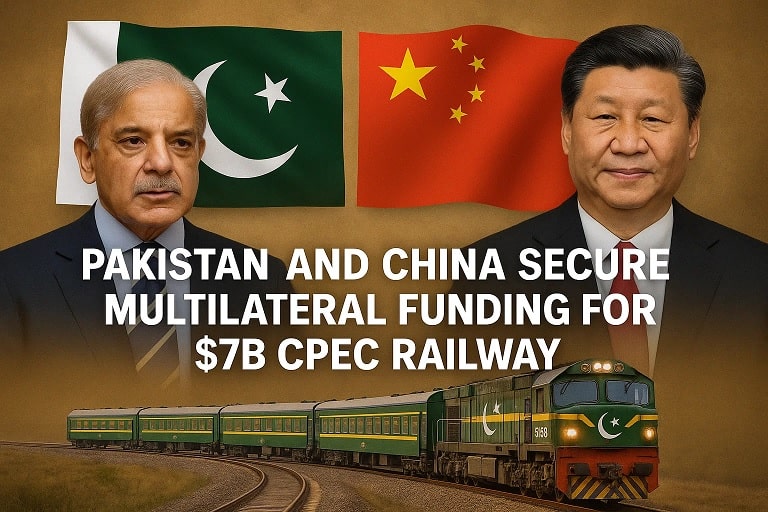
Pakistan and China Secure Multilateral Funding for $7B CPEC Railway: A Strategic Leap Forward
On September 9, 2025, Pakistan and China finalized an agreement to fund the $7 billion Main Line-1 (ML-1) railway project under the China-Pakistan Economic Corridor (CPEC) through a consortium of multilateral and bilateral partners, including the Asian Development Bank (ADB) and Asian Infrastructure Investment Bank (AIIB). This 1,700-km railway upgrade, stretching from Karachi to Peshawar, marks a pivotal step in CPEC’s second phase, aiming to modernize Pakistan’s colonial-era rail infrastructure. The deal, backed by a 2025-2029 action plan, diversifies funding to ease Pakistan’s fiscal strain while enhancing trade connectivity. This article explores the drivers behind this agreement, its historical context, future potential, and impacts, emphasizing India’s regional interests and Tamil Nadu’s role in supplying technology for the project.
Why This Agreement Matters
The ML-1 project, a cornerstone of CPEC, will boost Pakistan’s freight and passenger capacity by 70%, cutting Karachi-Peshawar travel time from 22 hours to 10. By involving multilateral lenders, the deal reduces Pakistan’s reliance on Chinese loans, addressing debt concerns amid a fiscal deficit exceeding $10 billion. For India, the project raises strategic concerns due to CPEC’s route through disputed territory but opens potential trade routes via improved regional connectivity. Tamil Nadu, with its advanced rail tech and electronics ecosystem, could supply signaling systems and IoT solutions, contributing ₹1,500 crore to its economy by 2030, aligning with India Mobile Congress (IMC) 2025’s infrastructure focus.
Latest Developments Driving the Agreement
The agreement, finalized after high-level talks during Prime Minister Shehbaz Sharif’s 2025 China visit, shifts ML-1 from sole Chinese financing to a multilateral model. Key highlights include:
- Multilateral Consortium: ADB and AIIB will co-finance the $7 billion project, with ADB leading the $2 billion Karachi-Rohri section. Negotiations for final terms are set to conclude by October 2025, marking a first for CPEC’s core projects.
- 2025-2029 Action Plan: The plan strengthens CPEC through trade, security, and cultural ties, integrating Pakistan’s 5Es Framework (Export, Environment, Energy, Ease of Doing Business, Employment) to align with global sustainability goals.
- ML-1 Scope: The 1,700-km upgrade will enable 160 km/h speeds, modernizing tracks, signaling, and stations, with construction targeted for 2025-2029 to handle 50 million tons of freight annually.
- Economic Context: Pakistan’s fiscal challenges, with $24 billion in external debt due in 2025, prompted the shift to multilateral funding, reducing reliance on China’s $30 billion CPEC loans.
- Complementary Investments: Alongside ML-1, $8.5 billion in CPEC deals for solar, EVs, and agriculture were signed, boosting Pakistan’s renewable energy and export capacity.
India and Tamil Nadu’s Context
India remains cautious of CPEC due to its passage through Gilgit-Baltistan, but enhanced rail connectivity could facilitate trade via the Wagah border. Tamil Nadu’s Chennai-based rail tech firms and Coimbatore’s IoT startups are well-positioned to supply advanced signaling, sensors, and EV components for CPEC trains, leveraging the state’s 10% share in India’s electronics exports.
Historical Context of CPEC and ML-1
CPEC, launched in 2015 as a flagship of China’s Belt and Road Initiative (BRI), has transformed Pakistan’s infrastructure landscape:
- 2015: CPEC announced with $46 billion, prioritizing ML-1 at $8.2 billion, alongside Gwadar Port and power projects.
- 2016-2018: Early Harvest phase completed 2,000 MW of energy projects and Gwadar’s initial development, but ML-1 faced delays over funding disputes.
- 2019-2022: Phase II launched, focusing on special economic zones; ML-1 cost revised to $6.7 billion amid security concerns and Pakistan’s IMF bailouts.
- 2023-2024: China hesitated on full ML-1 financing due to Pakistan’s $128 billion debt; ADB/AIIB emerged as partners.
- 2025: Multilateral funding secured, with ADB’s $2 billion commitment for Karachi-Rohri, signaling a new CPEC model.
Tamil Nadu’s rail modernization, including Vande Bharat trains, mirrors ML-1’s ambitions, offering expertise in high-speed rail tech.
Future Scopes and Projections
The ML-1 project could add $12 billion to Pakistan’s GDP by 2030, with broader CPEC investments reaching $15 billion annually. Key projections include:
- Freight and Trade: ML-1 doubles freight capacity to 50 million tons, boosting exports by 15% and linking Gwadar to Central Asia.
- Regional Connectivity: Enhanced rail could enable India-Pakistan trade routes, with Tamil Nadu exporting ₹1,500 crore in tech.
- Multilateral Model: ADB/AIIB funding sets a precedent for future CPEC projects, reducing debt risks by 20%.
- Job Creation: 100,000 jobs in Pakistan, with Tamil Nadu creating 5,000 indirect jobs via supply chains.
Long-Term Strategic Outlook
By 2035, CPEC could integrate South Asia with Central Asia, with ML-1 as a backbone. Tamil Nadu could lead rail tech exports, adding ₹3,000 crore to its economy. Challenges include Pakistan’s security risks, debt sustainability, and India’s geopolitical concerns over CPEC’s route.
Impacts on the Regional Economy and Stakeholders
The $7 billion project strengthens Pakistan-China ties but affects regional dynamics and India’s interests.
Sector-Wise Impacts
Transportation and Logistics
- Impact: ML-1 handles 70% of Pakistan’s rail traffic, cutting logistics costs by 40%.
- Economic Contribution: $5 billion in trade; Tamil Nadu supplies ₹800 crore in signaling tech.
- Business Opportunities: Chennai firms develop IoT for rail monitoring.
Energy and Trade
- Impact: Gwadar’s rail link boosts oil/gas trade; multilateral funding stabilizes investments.
- Economic Contribution: $4 billion in FDI; Tamil Nadu EV components add ₹500 crore.
- Business Opportunities: Coimbatore startups supply logistics sensors.
Geopolitical and Economic Stability
- Impact: Strengthens Pakistan’s economy but raises India’s security concerns.
- Economic Contribution: $3 billion in regional trade; Tamil Nadu benefits indirectly.
- Business Opportunities: Defense tech firms in Chennai support border monitoring.
Impact Snapshot
|
Sector |
Key Benefit |
Tamil Nadu Impact |
|---|---|---|
|
Transportation |
70% rail traffic capacity |
₹800 crore in rail tech exports |
|
Energy/Trade |
Gwadar trade links |
₹500 crore in EV components |
|
Geopolitics |
Regional stability |
Defense tech opportunities |
|
Overall (2030) |
$12B GDP addition (Pakistan) |
₹1,500 crore from Tamil Nadu |
Frequently Asked Questions (FAQs)
What is the $7 billion ML-1 project?
A 1,700-km railway upgrade from Karachi to Peshawar under CPEC, modernizing tracks for 160 km/h speeds.
Why multilateral funding?
Pakistan’s fiscal crisis and $30 billion CPEC debt prompted ADB/AIIB involvement, with $2 billion for Karachi-Rohri.
How does it impact India?
Raises concerns over disputed territory but opens trade potential via Wagah.
What’s Tamil Nadu’s role?
Supplies rail signaling and EV components, contributing ₹1,500 crore by 2030.
What challenges exist?
Security risks, debt sustainability, and India-Pakistan tensions could delay progress.


