

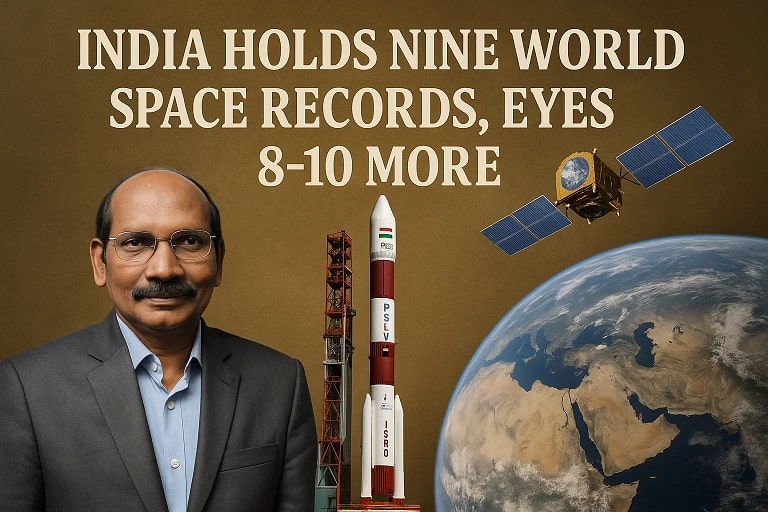
India Holds Nine World Space Records, Eyes 8-10 More: ISRO’s Ambitious Leap Forward
On September 9, 2025, ISRO Chairman V. Narayanan announced that India has achieved nine major world records in space missions since 2008, with plans to add 8-10 more in the coming years. Highlighting feats like the Chandrayaan series, Mars Orbiter Mission, and cryogenic engine technology, Narayanan emphasized ISRO’s cost-effective innovations during the All-India Management Convention’s 52nd National Management Convention in New Delhi. These accomplishments underscore India’s rise as a space powerhouse, with a space economy projected to grow from $8 billion to $44 billion by 2033. This article explores the drivers behind these records, historical milestones, future ambitions, and impacts, with a focus on Tamil Nadu’s contributions as a key player in India’s space ecosystem.
Why These Records Matter
India’s nine space records symbolize technological self-reliance and frugality, with missions costing a fraction of global peers—e.g., Mars Orbiter at $74 million vs. NASA’s $671 million. As the fourth nation to achieve space docking in January 2025, India eyes a $400 billion global space market share. For Tamil Nadu, hosting Vikram Sarabhai Space Centre (VSSC) collaborations and private startups, these records boost local innovation, potentially adding ₹5,000 crore to the state’s economy by 2030 through satellite manufacturing and tech transfers, aligning with IMC 2025’s space tech focus.
Latest Developments Driving the Records and Plans
ISRO’s recent announcements build on a series of successes, with Chairman Narayanan detailing the nine records and upcoming milestones. Key highlights include:
- Chandrayaan Series: Chandrayaan-1 (2008) discovered water molecules on the Moon, confirmed by NASA. Chandrayaan-2 (2019) deployed the highest-resolution lunar camera. Chandrayaan-3 (2023) achieved the first soft landing near the lunar South Pole and in-situ measurements there.
- Mars Orbiter Mission (2014): First Asian nation to reach Mars orbit on the maiden attempt.
- Cryogenic Engine Technology: Three records from 2014-2017 in LVM3 cryogenic stage development, enabling heavier payloads.
- PSLV-C37 (2017): World record for launching 104 satellites in one mission, including 101 foreign ones.
- Space Docking (2025): India became the fourth nation (after USA, Russia, China) to succeed in space docking, a key enabler for future missions.
- Upcoming Records: 8-10 planned, including Gaganyaan (human spaceflight, 2027), Venus Orbiter (Shukrayaan, 2028), Bharatiya Antriksh Station (2035), and crewed lunar landing (2040). NVS-02 navigation satellite launch in January 2025 and 10 orbital missions planned for the year.
Tamil Nadu’s Context
Tamil Nadu’s space contributions, from Sriharikota launches to Chennai’s private sector, support these records. The state’s 300+ space startups and Vikram Solar’s tech could aid future missions, creating 10,000 jobs.
Historical Context of India’s Space Achievements
India’s space program, starting modestly in the 1960s, has amassed records through innovation:
- 1975: Aryabhata, India’s first satellite, marking entry as the 11th space nation.
- 2008: Chandrayaan-1’s water discovery on Moon.
- 2014: Mars Orbiter’s first-attempt success.
- 2017: PSLV-C37’s 104-satellite launch record.
- 2019: Chandrayaan-2’s lunar orbiter camera record.
- 2023: Chandrayaan-3’s South Pole landing and measurements.
- 2024-2025: Aditya-L1 solar mission and space docking as fourth nation.
These nine records since 2008 reflect ISRO’s frugal engineering, with over 4,000 rockets launched and 133 satellites deployed.
Future Scopes and Projections
ISRO plans 10 orbital missions in 2025, including NVS-02 and Gaganyaan tests, aiming for 8-10 new records by 2030. Projections include:
- Gaganyaan (2027): First human spaceflight, training 40-50 astronauts.
- Shukrayaan (2028): Venus mission for atmospheric studies.
- Bharatiya Antriksh Station (2035): India’s space station.
- Crewed Lunar Landing (2040): Moon mission with Indian flag planting.
- Space Economy: From $8 billion to $44 billion by 2033, with private sector at 15% global share by 2047.
Long-Term Strategic Outlook
By 2040, India targets Viksit Bharat with 15% global space share. Tamil Nadu could host satellite assembly, adding ₹10,000 crore. Challenges: Budget constraints (₹13,416 crore in 2025) and skilled workforce needs.
Impacts on the Indian Economy and Stakeholders
The records position India as a space leader, boosting economy and security.
Sector-Wise Impacts
Space Technology
- Impact: Chandrayaan and Mars records enhance satellite tech; Tamil Nadu’s startups benefit.
- Economic Contribution: ₹20,000 crore exports; Tamil Nadu at 15%.
- Business Opportunities: Chennai firms develop payloads.
Defense and Security
- Impact: Docking enables space station; strengthens surveillance.
- Economic Contribution: ₹10,000 crore in defense tech.
- Business Opportunities: Coimbatore integrates for Gaganyaan.
Education and Startups
- Impact: 300 startups; IITs train for missions.
- Economic Contribution: ₹5,000 crore in innovation.
- Business Opportunities: Tamil Nadu’s 100 startups scale.
Impact Snapshot
| Record/Achievement | Year | Tamil Nadu Impact |
|---|---|---|
| Chandrayaan-1 Water | 2008 | Boosts satellite R&D |
| Mars Orbiter | 2014 | EV tech transfer for space |
| 104 Satellites | 2017 | Chennai assembly hubs |
| Chandrayaan-3 South Pole | 2023 | ₹5,000 crore in startups |
Frequently Asked Questions (FAQs)
What are India’s nine space records?
Chandrayaan series (water discovery, South Pole landing, lunar camera), Mars first-attempt success, cryogenic engines (3 records), 104-satellite launch, space docking.
What are the 8-10 planned records?
Gaganyaan human flight, Shukrayaan Venus, space station (2035), crewed lunar landing (2040), plus 10 missions in 2025.
How does Tamil Nadu contribute?
Hosts startups and tech for satellites; adds ₹10,000 crore by 2030.
What challenges face ISRO?
Budget limits, skilled manpower; needs 40-50 astronauts.
How do these boost India’s economy?
Space economy to $44 billion by 2033; 15% global share by 2047.


